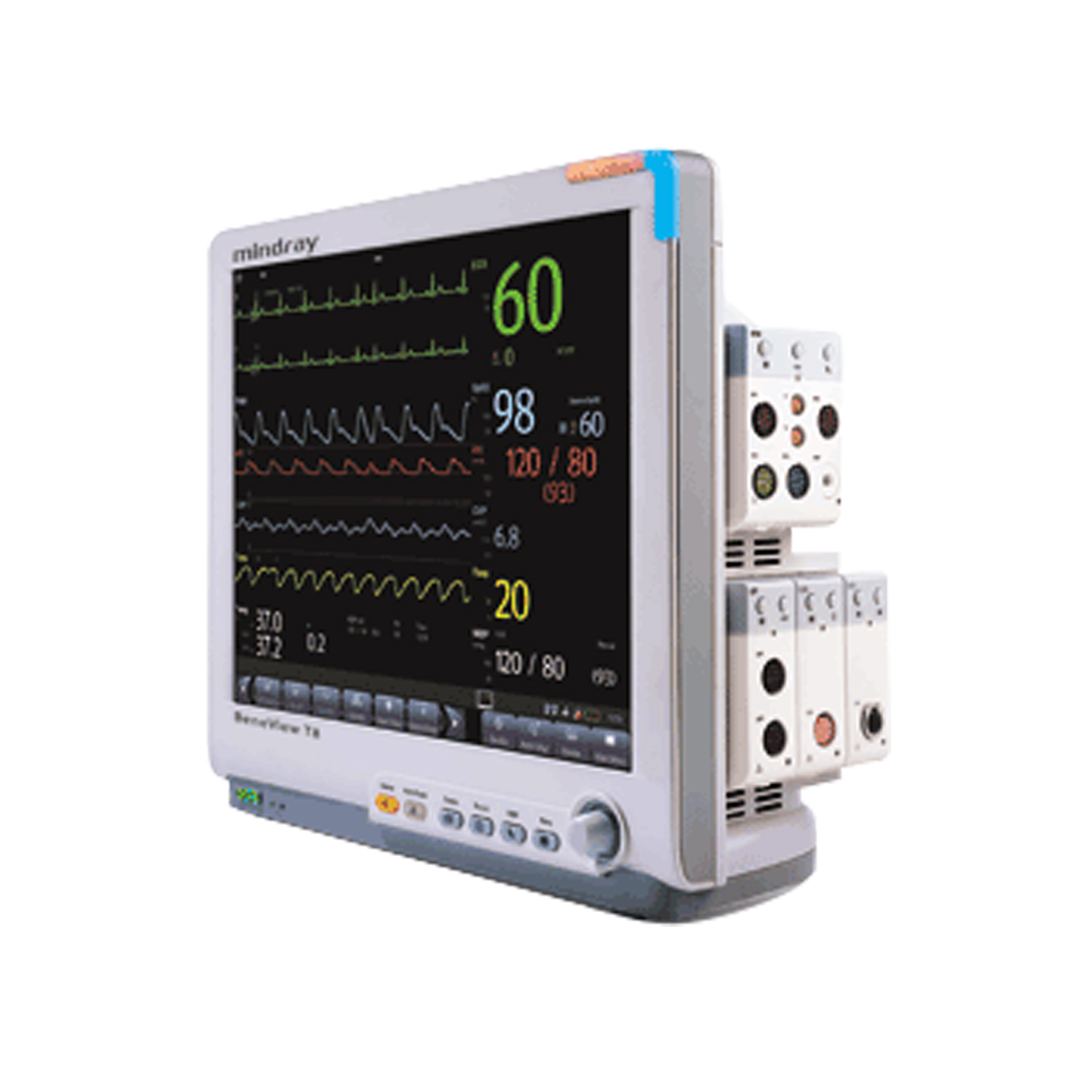
About the Mindray BeneView T8 Patient Monitor
The BeneView T8 runs three extended screens simultaneously, letting your staff track vitals, ventilator data, and network information without toggling between views. That’s the short version of why this monitor stands out in busy units where screen real estate matters.
With 13 module slots, you can configure monitoring setups that actually match your patient mix rather than working around fixed limitations. The multiple input options (touchscreen, knob, keyboard, mouse) mean staff can interact however feels natural during different procedures. Worth noting: the integral recorder prints locally or pushes to networked printers, so you’re not tied to one documentation workflow.
The rechargeable Li-ion battery provides genuine mobility during transport, while user-configurable quick keys let each department customize the interface for their common tasks.
Key Features
- Three extended screens for separate simultaneous views
- 13 module slots for flexible configuration
- Multiple input methods: buttons, knob, touchscreen, keyboard, mouse
- Audible and visual alarm indications
- User-configurable quick keys and quick-function buttons
- Integral recorder with networked printer option
- Rechargeable Li-ion backup battery
Specifications for Mindray BeneView T8 Patient Monitor
Sizes
- Dimensions: 400 mm (W) x 370 mm (H) x 193 mm (D)
Weight
- Weight: 10.5 kg (Standard Configuration)
Power Requirements
- AC Input: AC100–240V, 50/60Hz (±3Hz), 2.8–1.6A
- Backup Battery: Rechargeable Li-ion battery (2 hrs working time listed)
Operating Environment
- Temperature: 5–40 °C
- Humidity: 15–95% non-condensing
Patient Range
- Patient Types: Adult, Pediatric, Neonatal
Data and Storage
- Full Disclosure: Up to 48 hours of waveforms and numeric data
- Trends: Review up to 120 hours of tabular and graphic trends including OxyCRG
- Storage: CF Storage Card
Modules and Connectivity
- Module Slots: 13 module slots for flexible configuration
- Interfaces: Clinical information system or central monitoring system
Measurements and Alarms
- Alarms: Systolic, Diastolic, Mean (NIBP)
- Alarm Indications: Audible and visual indications